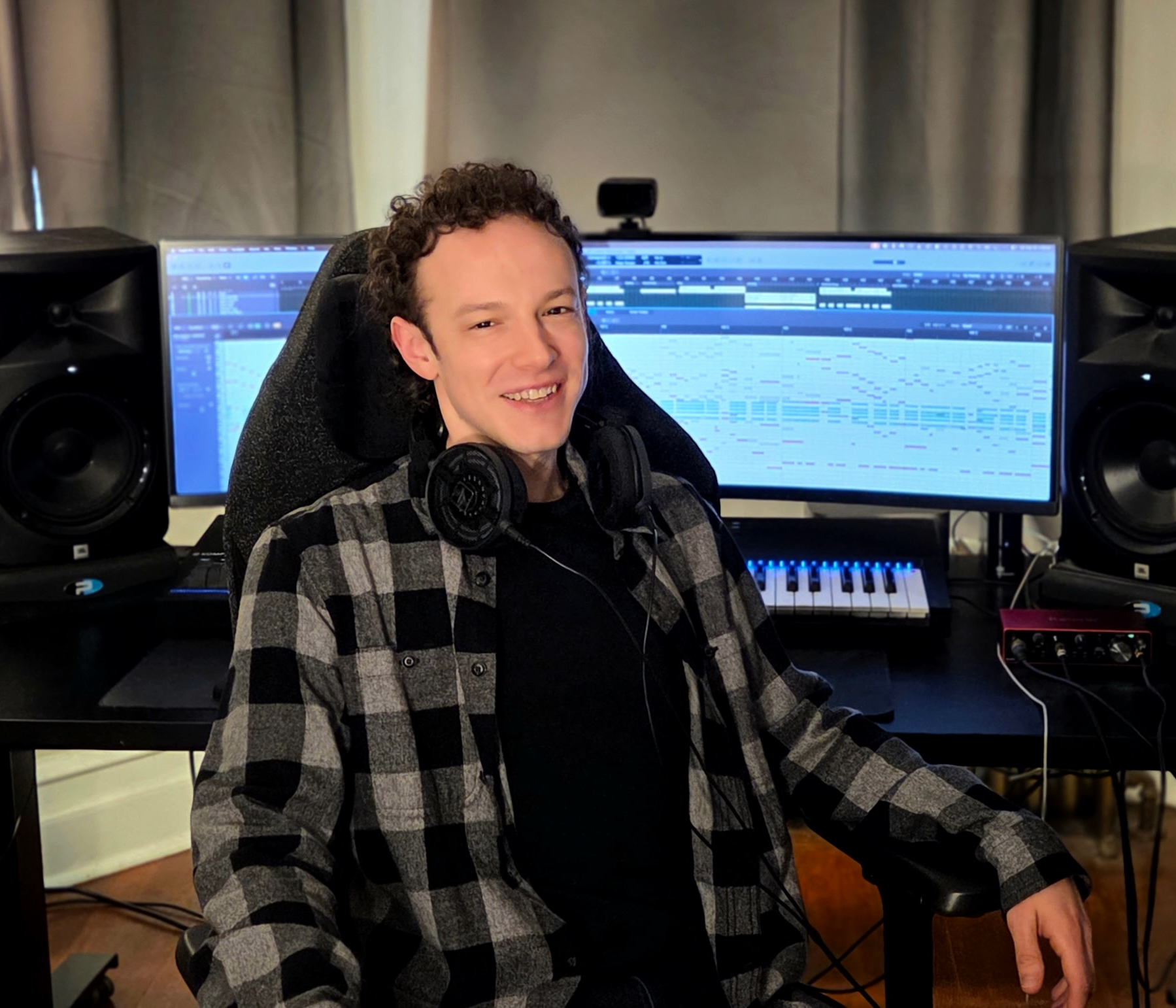
Hi, I'm Avery. I've been making music in DAWs since 2008.
I started as a YouTube artist, uploading new tracks weekly. I grew to 2 million+ streams, got a few tracks signed, and won 2 music awards.
Then a music library reached out to place my music on TV, and I became a working composer. I wrote hundreds of tracks, which were heard billions of times in thousands of videos, shows & games.
As my work grew, I started getting questions from other producers, so I started teaching lessons. This became a great passion, because I get better by helping you get better.
After many lessons, I realized that most people were struggling from the same fundamental things. So I made videos teaching those things. That's where my course came from.
Below are reflections on a few chapters in my life.
Pt 1: How I fell in love with the piano roll
It was 2007. I’m in high school.
I had taken guitar lessons for about a year. Knew just enough to struggle through basic chords & scales.
One day I visited a friends house. She asked me if I ever used Logic Pro.
I hadn't.
So she showed me a little techno project she had been working on. It was exciting to see.
Then she opened the piano roll.
“You can just pencil in the notes you want, and it plays them??”
It felt like a door I didn’t know existed had just swung open.
I got home and installed Logic right away on my little laptop.
I stayed up all night clicking in notes.
By sunrise, I had my first song.
I called it “Summer Breath.”
Stock guitar, strings, piano.
Nothing fancy.
But it didn't matter - for the first time, I could hear the ideas in my head come to life.
No being held back by my clumsy hands on the guitar.
It felt like musical freedom.
I could try something, change it, try again…
Until it gave me goosebumps.
“Oh, this is my instrument.”
I had no idea that what I was doing was "composing." I was just writing notes until I liked them.
That was more than 15 years ago.
Not much has changed.
I’m still sitting here doing the same thing...
Writing notes in my piano roll.
Pt 2: How I built a fanbase on YouTube
TLDR: I upload tracks to YouTube. Views snowball into 1 million+, bringing a fanbase, 2 awards, and the validation to keep pushing in music.
--
It’s 2012.
I’m in college, a few years into making tracks in Logic.
I’ve been uploading here and there.
No real plan. Just messing around.
But something shifts, and I decide to take music more seriously.
I pick a popular track at the time - Calvin Harris’ “Feel So Close” - and remix it.
I upload to YouTube, and drop $2 a day in ads just to see what happens.
Views come in.
Then comments.
People actually like it.
I reply to every single one.
Even the haters.
The track hits 50,000 views.
I stop the ads - but the views don’t stop.
100,000 views.
Fireworks are going off inside.
People are listening. Reacting.
It feels right.
So I make a promise to myself:
Finish and upload one track a week.
And I stick to it.
Every week - new track, a couple bucks in ads.
Familiar names start showing up in comments, cheering me on.
I set up a Bandcamp and link it from my videos.
Start selling homemade CDs.
I draw robots and disco balls all over the discs with a sharpie.
Include handwritten thank-you notes.
Drive to the post office and mail them one by one.


A couple tells me they got married to one of my songs.
My first paying production client comes from a listener.
Views close in on a million.
Then a radio station in LA starts playing my stuff.
By year’s end, I’m the fourth most-played artist on the station.
They hold an award show and nominate me in three categories.
I ask my YouTube community to vote.
They do.
I fly to LA with my family.
Walk the red carpet.
Talk to reporters while cameras flash.
Meet other artists.
Win 2 awards.
Shout my thanks semi-awkwardly on stage as I go up to accept them.
And walk out feeling on top of the world.
I’ll never forget that night.
It was the first big high.
All of it started with tracks uploaded to the internet from my bedroom.
I wasn’t making much money...
But it gave validation.
Music was the path.
--
Lesson: When you share from excitement, you attract new friends and supporters into your life.
Do you have any fond memories of sharing your music?
Pt 3: How I got my first TV placement
TLDR: Despite lots of attention on my music, I can't figure out how to earn an income with it. I stumble into my first TV placement which gives me new hope and a path.
--
It’s 2013.
I’m fresh off flying to LA, winning two awards, passing a million YouTube views.
Fans leaving comments every day.
On the outside, it looks like I’ve got it all figured out.
On the inside, it’s all crashing down.
Because despite all the payment in praise - I can’t figure out how to turn it into payment in dollars.
And even though I’m incredibly grateful… at this moment, I need the dollars.
I’m still living with my parents.
It’s time to move out and stand on my own.
I have some savings, but not enough to feel stable.
I try everything I can think of:
-
Pushing Bandcamp sales
-
Selling T-shirts
-
Little giveaways for donations
-
Cold-emailing labels to mix or produce their artists
It all works… a little.
But not enough.
And slowly, my energy shifts.
I stop sharing from excitement.
I start sharing from desperation.
People feel it.
Views drop.
Comments slow.
I get more desperate.
It’s a spiral.
Then one day, an email shows up.
A music library owner found my tracks on YouTube.
He thinks they’d fit reality TV perfectly.
Wants to hop on a call.
We sign a contract.
A few months later, my first placement hits - an MTV show called Guy Code.
The check arrives.
It’s only a few hundred dollars.
But it feels different.
It feels like hope.
No begging for sales, no pushing merch, no need to get endless streaming numbers.
The music just spoke for itself.
And it opened a door I didn’t even know existed.
This became the way forward: learn the licensing game and double down.
--
Lesson: Positive attention gives fuel, but can’t sustain a creative pursuit alone.
Have you ever had a moment that challenged your drive to continue music?
Pt 4: How I became a full time composer
TLDR: Struggling to get consistent sync placements, I turn to stock music. It brings enough income to go full-time, and challenges me to become a legitimate working professional.
--
It’s 2014.
I had just earned a few hundred dollars from my first TV placement on a show called Guy Code from a library deal.
I’m about to move out of my parents’ house. I need something to work.
Licensing gives me hope. It feels like the path.
So I hunt for every "submission opportunity" I can find.
Lots of them need music styles I hadn't made before.
I write to them anyway, submitting constantly…
Luckily, some of them hit. I scrape a few thousand dollars here and there.
But it quickly becomes clear:
If I want to make this work, I need to get a lot better.
*DING* - A Facebook message comes in.
It’s from a guitarist named Will. He’s the brother of an old bandmate. He’s getting into production and looking for feedback.
He sends a link.
The sound is rough.
But the writing is awesome.
He’s looking for opportunities too. I tell him about licensing.
He’s into it.
We meet at my place and try making something together.
The chemistry is instant.
Two hours later, we have a finished track.
We decide to try the licensing business together.
We write to briefs.
Mostly rejections. But also land a few placements.
It’s encouraging - but also feels like a roller coaster of randomness with no clear direction.
Then an old mentor drops a tip: “You guys should try AudioJungle.”
It’s a stock music site where anyone can upload tracks and people around the world can license them - from a few bucks to $500 a pop.
People on forums said to stay away from it. “Keep submitting to the high-paying stuff” they said.
But what did we have to lose?
We write our first “stock” tracks and upload them.
Sales trickle in almost immediately.
We’re shocked.
It feels like something real might be here.
We keep uploading, promising ourselves we’d celebrate if we hit $1,000.
We hit it. Pop a champagne bottle in my kitchen.
Then we upload a “reject” track we’d written for a brief that didn’t get picked.
We called it Rock the Party.
And it changed our lives.
Almost overnight, it takes off.
It climbs the charts. Sales roll in daily.
$15, $50, even $500 licenses.
It hits the top new sellers.
Then the weekly bestsellers.
Every sale means another project somewhere in the world is using our music.
From small YouTubers to big brands like Uber, Adidas, American Airlines.
We download apps on our phones that push a notification every time we get a sale.
We’re getting fired up as our phones “ding” with sales each day.
We keep uploading.
No track matches Rock the Party, but the steady trickle adds up.
Within months, we’re paying rent and bills with music.
For two twenty-somethings chasing the dream, it’s life-changing.
Our rank on the platform starts climbing.
“You are ranked 500th for sales on AudioJungle.
300th.
138th.”
One day we cross $75,000 in sales - hitting “Elite” status.
AudioJungle sends a congrats letter, a T-shirt, and a keychain.
The shirt’s too small. But I love it.
It made everything feel real.
Other libraries start finding us and ask if we can create tracks for them too.
Now we’re writing for “official” television and advertising briefs.
100 tracks… 200 tracks…
$100k… $200k…
We had built a little machine.
A two man music biz fueled entirely by hope and a stubbornness to keep our heads down, and our uploads flowing.
This experience transformed us - from two kids making random tracks in our rooms to legitimate music craftspeople.
Because to survive, we had to write and produce what the market wanted - at a professional level - constantly.
I paid for lessons, took courses, drilled skills like my life depended on it.
Because it did.
This experience taught me to see the bigger picture of music.
To hear through genre to the fundamentals underneath.
To pick apart reference tracks fast and make my own music using the same principles.
To develop workflows that allowed me to finish tracks even when I wasn’t feeling inspired.
But it wasn’t all happily ever after.
By focusing 100% on making tracks that fit “the market,” my own untethered creative voice began getting quieter.
It no longer had a safe space to play.
Instead, each track needed to “work.” No room to take risks.
So it slowly stopped trying to cut through, leaving me to my carefully created workflows and formulas.
It would be years before I created that safe space for play again.
Because right now, I needed to fuel the business I had worked so hard to build - and feed the machine.
--
Lesson: Consistency fuels growth. But if you aren’t careful, it can steal the space to play.
Have you ever stumbled into something that gave you what you needed, but quietly took something you didn't expect?
Pt 5: How I composed a theme for a TV show
TLDR: I rent a local recording studio and end up doing a theme for a TV pilot. It taught me about how to deliver in stressful situations and make music for other people's goals.
--
It’s 2017.
Stock music income is coming in steady.
My biz partner Will has been eyeing a studio space in town. He wants to setup shop to take on recording clients.
I’m a bit hesitant. But he sees a vision.
He signs the lease and drags his desk and computer in.
Takes on a few band friends as first clients.
Shortly after I join him.
We’ll grow it together.
So we put our stock sales towards the rent.
Throw posts on Craigslist, tell friends, take whoever walks in.
We get bites.
Rock bands, rappers, experimental artists.
We drive there almost every day - recording, producing, mixing, consulting.
We’re actually running a real studio - not just two guys in our rooms anymore.
All of it on top of regular uploads to our stock store.
It’s tough.
And the pay isn't great.
But showing up feels like the right thing.
Then one day, an artist I’d mixed sends a message:
“My friend is producing a TV pilot in NYC. They need original music and a mix on the show. Want an intro?”
We jump on it.
They send the opening sequence.
We write five different intros - five different vibes.
We even sneak a spicy secondary dominant into one. (We loved it - they hated it lol.)
Their favorite ends up being straight-ahead rock. Clean, energetic.
They want to work with us.
Budget: $3,000 for all the music. Half up front, half on delivery. A little extra for the mix.
We say yes.
It would cover rent and give us more experience.
So for the next few months it’s back-and-forth files on top of the recording clients in the studio on top of the stock uploads.
They’d send edits.
We’d send revisions and ask for feedback.
Deadlines get tight - sometimes we’re working into the night.
We’re sitting on the floor eating hummus and pita chips off a guitar case.
“We’ll laugh about this one day,” we tell each other.
Then comes the night before final delivery.
The director drives up to see us in person.
We grab dinner, come back to the studio.
He drops last-minute changes.
We make them together.
He thanks us, heads out, says:
“I need everything in an hour.”
Door closes.
Will and I look at each other: “Oh shit.”
We race to the DAW.
Re-check the edits, confirm loudness, hit export…
40 minutes remaining.
We pace the room.
Upload with minutes to spare.
It all goes through.
A wave of relief.
We did it.
The pilot gets a small test premiere.
We drive to the city, meet the cast and crew at a restaurant.
The energy is electric.
They give speeches thanking everyone involved.
It feels good to be in the room.
Unfortunately the show never goes further - but the reality is most pilots don’t.
A few months later, we close the studio and move back to our home setups.
After over a year of serving clients in person, we realize almost everything we were doing we could do remotely anyway.
Save the rent, and the commute.
We learned what we needed to.
How to swallow ego, hit brutal deadlines, make sense of confusing feedback, work in-person and over distance, and stay calm through a rapidly changing process.
We carried those lessons into everything that came after.
--
Lesson: Being a pro is more than just skill in the craft - it’s also proactive communication and problem solving.
Have you ever done an unexpected project that pushed you to to higher limits?
Pt 6: How I became a ghost producer
TLDR: I become a ghost producer for a touring DJ, finish multiple remixes a month, produce an original that gets 1 mil+ streams - and learn more than ever how to drop ego.
--
It’s 2018.
I’ve shut down the local recording studio and gone back to fully remote work.
Just me, a cozy home studio, and my dog sleeping in his bed next to me.
I realize that’s how I like it.
The stock music income is still flowing - like a steady heartbeat keeping everything afloat.
Work comes in from online marketplaces like SoundBetter and Fiverr Pro.
Indie artists, game devs, a custom for Volkswagen. (Stories for another time.)
Then one day I’m eating breakfast, when I get an email I’d never expected.
It’s from a DJ with a solid following. He’s looking for a new ghost producer. His last one quit.
He’d heard my demos and thought I could match his sound.
I’d never ghost produced before. Hadn’t ever even crossed my mind.
But if I could pull it off, it meant ongoing work.
So I put my reservations aside, studied his references, and made a demo.
He was impressed. Seemed like this could work.
First job: A remix of a popular song in his style.
I spend a few days on it - then send it over.
He had some notes - the drums needed more energy.
He sent me his own samples. I swapped them in.
It felt good. He gave the green light.
I took a day to master it - then sent over the files.
A week later I get a message: “I played it live last night. Here’s a video.”
Flashing lights, massive screen behind the DJ booth, packed dance floor - everyone moving to a track made during a few quiet nights in my home studio.
It felt surreal to see. I’d always seen my music used in placements, media, TV - it felt good, but a bit detached.
This was different. More visceral. I could see the people who it was hitting.
But it also felt strange.
No one in the room knew I existed.
But I couldn’t dwell on it.
He sends another project.
And another.
We’re knocking out multiple remixes every month.
I get faster. The tracks get stronger.
He tells me some of our tracks had been picked up by other DJs - being played at big events.
Sometimes we’d hop on Zoom and he’d flip the camera - showing me a beautiful hotel balcony halfway around the world.
It was fun to see the lifestyle up close - and the more I saw it, the more I understood my position.
Constant travel.
Constant pressure for new material.
Constant image management.
It looked exhausting.
Ghost production had made me feel odd at first, but eventually I got clear on my place in it.
I didn’t want his life.
I just wanted to make the music.
And he needed someone to trust in his corner.
After about a year, he asks if we can try an original.
So I build an instrumental. He sends it to his vocalist who records the first version on her iPhone.
I bring it in, throw heavy FX and EQ, and make it work.
She records the next version in a real studio. Her performance comes alive.
I mix it in and send it out.
They shoot a video.
It crosses a million streams.
We celebrate.
Then it’s back to remixes.
This work taught me so much.
How to pick grooves that work on a dance floor.
How to build huge moments with only a few notes.
How to create intros and outros that mix well into other tracks.
But more than production - how to let go of ego like never before, and be a secret weapon that helps someone else grow their career.
These were invaluable lessons I’d take with me.
But it also hit me with a long building realization.
For years, everything I’d done had been behind the scenes.
Clients, libraries, a stock store.
I needed to create a new outlet.
One for me.
No briefs. No approval process.
Just a spot to make whatever. And let it reach whoever.
What would I even make?
--
Lesson: Sometimes the role that pushes you to new heights is “secret weapon” - not “main character.”
Have you ever felt like you might be neglecting a part of yourself by focusing too much on doing work for others?
Pt 7: How I stumbled into 50k+ IG followers
TLDR: After struggling to find traction, I stumble into a format that works for me and grow my Instagram to 50k+ followers, building an organic business on music ideas & teaching.
--
It’s 2021.
I’ve been working behind the scenes in music for almost a decade.
Library briefs, custom gigs, stock.
Hundreds of tracks.
Built to fuel someone else's vision.
It was time to make a new outlet.
One for me.
Where I could make whatever. And let it reach whoever.
It was scarier than I thought. There’s a certain safety when you work in the background.
But it was also exciting.
I remember how good it felt to connect when I was on YouTube.
Random strangers became friends, and changed my life.
Had it really been almost 10 years?
I wanted that again - in whatever way it took shape for today.
So I take a page from the playbook that had worked before:
Pick a spot and show up consistently.
I chose Instagram - I already had an account. Might as well use it.
So I start posting project clips.
Little production tricks.
A few awkward talking-head type stuff.
It’s slow.
Handfuls of detached comments and likes, some from friends being nice.
Then one day I sketch something in my favorite piano plugin.
No polish. No fancy tricks. Just some notes I liked.
What the heck - I’ll throw it up. Maybe I’ll slap the chords I used on it too.
It gets more love than usual.
I wasn’t expecting that.
So I do another. And another.
It’s reaching more people. I’m getting nice comments.
No flexing. No fancy setup. No polished production.
Just writing something that felt nice and sharing it.
What I’d be doing anyway if no one was watching.
*head slap*
Of course that’s what I should be doing.
So that’s what I do.
I write ideas. Whatever feels cool. And I share it.
The account starts growing.
2,000 followers… 5,000… 10,000…
The DMs start coming in.
People who are inspired by the content.
People who want to learn deeper with me.
People who want to use my ideas in their own tracks.
So I take on more students. Many turn into friends.
I build my first course. Hundreds of producers take it, sending wonderful messages about their experience that light me up.
I release my first packs. I start getting DMs from people who use the ideas in ways I would have never expected.
And suddenly a little business had formed.
One that felt different than everything else I'd done... because it was built 100% on organic creation.
No one told me what to make. I just made whatever I wanted.
And the people that resonated came into my world.
It felt like what I had been missing.
The industry work brought income and accolades. But it never gave human connection.
This filled that void.
It was an important lesson about fulfilling the different sides of your needs as a creator.
But all this on top of the library briefs, clients and stock store...
A vague resistance starts to form.
Burnout.
Quietly rising.
I ignore it.
There's too much cool stuff happening to slow down.
--
Lesson: When you share from what excites you without expectation of results, it creates connection in a way that is hard to manufacture.
Have you ever felt yourself ignoring burnout because you were afraid of losing momentum?
Pt 8: How KSHMR used my melody in a track
TLDR: Burnout from daily posting and production work forces me to step back. In the break, an unexpected credit lands in my lap, and I find the space to reconnect with why I fell in love with music.
–
It’s 2023.
I’ve been posting music ideas to Instagram every day for over a year.
My account’s grown past 50,000 followers.
But the daily post on top of my normal production work is taking a toll.
I can’t keep up.
I start reposting past content to fill my self-imposed quota.
People don’t seem to mind.
But I do.
I'm quietly slipping out of alignment.
I need to step back. Find the space to reflect & recharge.
As I start planning to pull back, my phone lights up with a new comment.
“You’re good at writing melodies my friend.”
It’s from KSHMR.
I blink in disbelief.
I’d broken down his tracks note by note.
Rebuilt his sounds from scratch.
He was one of the producers who made me believe melody still mattered in electronic music.
Heck, his samples are in my production template.
And here he is, complimenting me on the exact thing I appreciated in him.
I DM him to say thank you. I tell him the impact his music had on me.
We chat a bit. He asks me to send some melodies.
I do.
He likes them.
He asks if I’d be interested in releasing a pack together.
A pack with KSHMR? Burnout be damned - I’m in.
So I go deep.
Write hundreds of new ideas, remix old ones…
I send him progress updates. He says they're great.
Despite a decade of professional work, this validation hits different.
I keep working.
Another message comes in.
He used one of the melodies for a new production. Wants my permission to release it and leave credit.
He sends a private link to the track.
There it was - my melody opening the track & in the drop, full vocals inspired by it.
I tell him of course - and thank you.
It was a bit surreal.
I had just achieved a bucket list moment.
A credit with an artist I had studied and been inspired by.
No chasing. No following a brief.
100% organic pull.
It was a reminder:
Some of the most meaningful achievements aren't made through careful planning and pushing.
They're made by simple sharing and attracting.
You just have to let yourself and your work exist in public.
It can be that simple.
The irony that I am sitting with this reminder during the most acute burnout of my life.
10 years of constant creating.
Artist releases.
Stock uploads.
Library tracks.
Custom gigs.
Private lessons.
Daily posts.
Course content.
MIDI packs.
I realize it's not even about the workload.
It's about the clarity of thought.
What am I doing? Why am I doing it?
Is it even intentional anymore?
Am I just living in the unquestioned beliefs of past versions of myself?
This is the thought that makes me finally stop.
With some guilt, I thank KSHMR but tell him it’s not the right time. I hit burnout. I need space to recalibrate.
He’s completely understanding. The door is open whenever.
Makes me respect him even more.
I go completely dark from public.
I thought I’d step away for maybe a month or two…
It turned into over a year.
Then two.
I still made tracks.
Worked with clients.
Held lessons.
But I did it all in quiet now.
No posting. No public releasing.
No high pressure goals or deadlines.
Just existing inside what I’d built for a bit.
And in that space, something I didn't realize I desperately needed happened.
The pressure of constant output lifted.
And I listened to music… just for fun.
Not to reference.
Not to study.
Not to transcribe.
Just to enjoy.
The way I used to before it became a career.
Dancing alone at 2 am, blasting music in my headphones, tears in my eyes from the euphoria.
Whisked back to the wide-eyed excitement I felt the first night I opened Logic.
The energy that started it all...
But somehow gets pushed to the side as you adapt to "how the industry works."
Yet creates the spark that makes everything possible.
The first YouTube uploads that brought awards and community.
The stock track that took off unexpectedly and helped fuel an entire career as a music craftsperson.
The piano sketches built from curiosity that grew the IG... and eventually attracted KSHMR.
I am reminded that this is the most valuable energy we have as creators.
It is curious.
It is excited.
It is innocent.
It creates for it’s own sake - not for a transaction.
And it attracts automatically.
It holds a wisdom from nature.
You can grind, climbing a ladder of achievements.
And that’s fine - healthy, even.
But don’t lose yourself along the way.
Like the Midas Touch, you might find yourself surrounded by gold, slowly dying from starvation.
In the quiet I am given new perspective that a healthy life as a creator means a life of balancing.
Money and art.
External expectations and internal guidance.
Childlike curiosity and planned intention.
It’s not one or the other.
It’s both.
The ultimate art is the balance.
A balance you will never find in a video or course.
A balance learned through experience and reflection.
A balance that may never be mastered - and that’s the whole point of the pursuit.
This is the balance I hope to be more respectful of today.
To share from it.
To teach from it.
And to help you cultivate in yourself.
To empower the voice of your inner child - armed with the skills of the adult logician - building a mature creative energy to flow freely and fuel your life.
Whatever that looks like for you.
–
Lesson: Sometimes you need to turn down opportunity to rediscover the “why” that keeps your work meaningful.
Have you ever realized you needed to step back to rediscover what made you fall in love with your craft?
Thank you to my teacher
In late 2025, a teacher who deeply impacted my relationship with music passed.
On my birthday I visited him in hospice to thank him.
Even on his deathbed, he gave me a lesson on the importance of form in music.
At the funeral, I saw other students he had touched.
His music books lined the wall at the reception. We were encouraged to take some.
I took The Lydian Chromatic Concept of Tonal Organization for Improvisation for All Instruments published in 1959.
When I opened it up, papers fell out where he seemed to be adding nuances to the perspectives in the book.
Classic Gilbert.
He was eccentrically passionate about music, and music theory.
But he didn't just teach notes - he taught how to think and hear.
Because he taught from lived experience rather than a textbook.
- He would raise his arms and shout during our lessons about tonic and subdominant relationships.
- He would curse up a storm, excitedly talking about how all music is tension and release.
- He would show me noise music I didn't even know existed, closing his eyes while imitating the sounds with a big smile.
- I'd show him a melody I wrote, and he'd say "Good. But add 4 harmony voices to it."
- He'd give me a set of 5 notes, then tell me to fill up the page with all the different chords those 5 notes could be.
He challenged me to think differently about music.
To see it from a bigger picture.
I'll never forget: One day I was struggling. He paused, looked at me, and said:
"Avery, your problem is you see all these notes as separate things.
You see a chord progression, and a melody, and a bassline.
Stop fragmenting them so much.
See it all as one thing."
This was a lightning strike of an "AHA" moment.
The way he showed me to think, allowed me to teach myself just by listening.
Which in some respects, is the most ultimate lesson of all.
He also wasn't perfect.
He struggled with addiction issues.
Some lessons I'd show up and he'd be visibly intoxicated.
Never stopped us from having a 3 hour lesson, though.
Sometimes he'd forget how to meet me where I was at, and he'd be teaching from far above where I was at the time.
But we all have flaws.
And those flaws are part of our unique genius.
If it wasn't for him, I doubt I'd be writing this email today.
Because I'd probably have never gotten this far.
Thank you Gilbert Plantinga, for being who you were.
You lived and shared music - to the very end.
You're the real deal.