From Sketch to Finished Production
Learn music theory & song-sketching in the piano roll
Take this course to quickly sketch music from scratch - then finish your ideas into full tracks.
Enroll Now - Lifetime Access
30 Day Guarantee: Love it or your money back.
Free consultation available before enrollment if desired: a[email protected]

Built from 10+ Years as a Working Composer
Writing music from scratch shouldn't feel frustrating.
Sketch to production is the modern producers guide to music theory & from-scratch composition in the DAW.
It is not about a specific genre - instead, it is about the fundamentals you need to write any kind of music.
You will gain the skills to "sketch" chords & melodies quickly, bring them to life with sounds, then finish your favorites into full songs.
These lessons are different because they were not made in a classroom - but from the exact same frameworks built to support 10+ years of professional production work, writing & finishing music every day, on a schedule. (KHSMR, Volkswagen, Mobile Legends Bang Bang, Major League Baseball)
It is a perfect fit for producers who want to see the bigger picture and create with more intention, knowing what you're doing and why.
All you need is a mouse and piano roll.
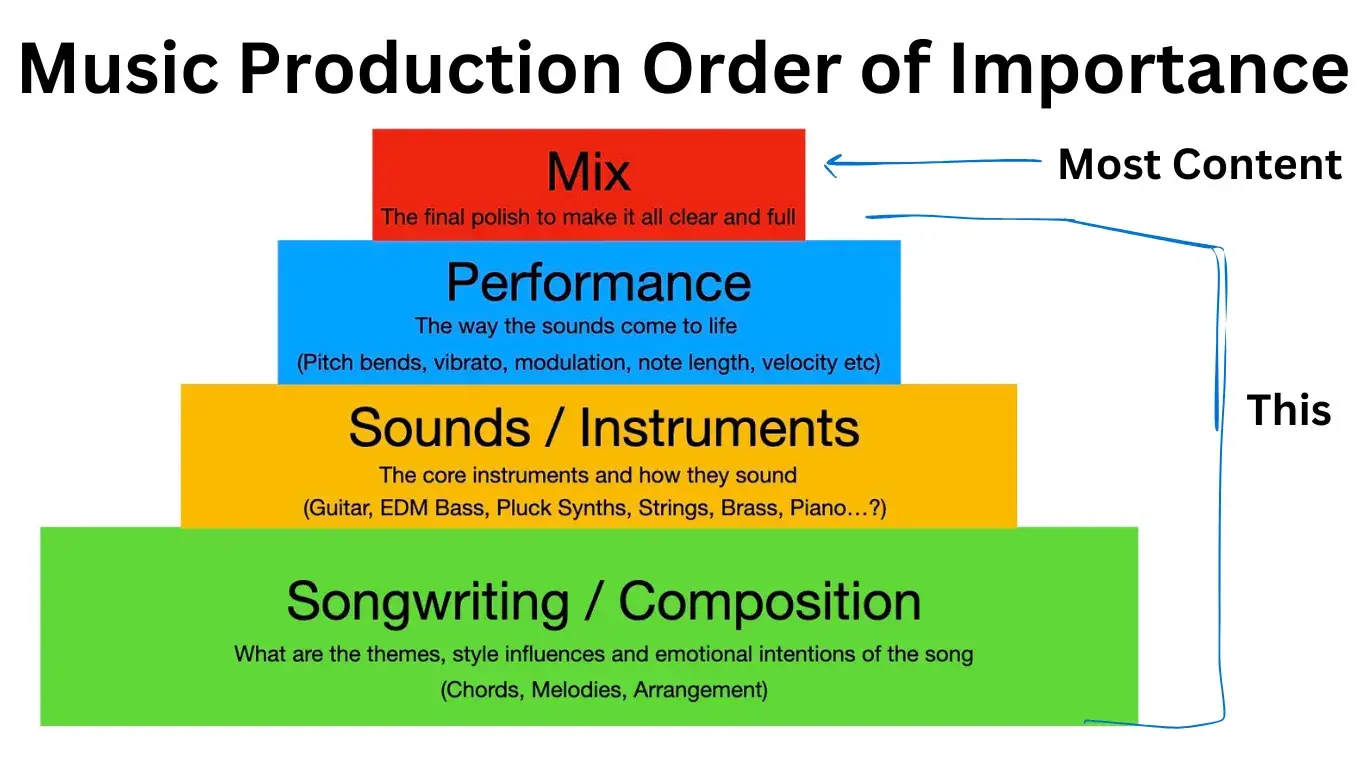
The above image is a simple way to view the music making process. It has 4 clear "pillars."
Composition - the actual notes, rhythms, and arrangement. Without this, there is nothing. That's why it's the bottom pillar that everything above rests on.
Sounds - every sound tells it's own story and brings it's own emotions to the notes you wrote. This is a huge part of what makes a genre, a genre.
Performance - this is where the sounds come alive - because part of what separates the beginner and the pro is not what they play, but how they play it. That's performance.
Mix - this is where you make whatever you wrote sound clear, full, and colorful.
Something important to notice is how most tutorials & courses you find online seem to focus entirely on mixing and plugins - but this never touches the pillars underneath that support it.
This is exactly why so many producers are stuck even after taking courses and watching thousands of hours of videos. They learn so much about EQs and production technique - but never built the foundations for how writing music actually works.
This is like wanting to become a chef, but only learning about presentation of the food, instead of how to prepare it and cook it!
This course is where we fix that for you.
We focus on the lower pillars so you can make music that feels alive even with just a minimal, basic mix.
So practically: You can write and finish music anytime you want, following a reference track or the ideas in your head.
And spiritually: You can become a vessel for music to effortlessly flow through you.
Here's how:
- First you learn fundamentals - so you understand how music works. Chords, melodies, rhythms, workflows. These help you learn the "alphabet" of the language of music.
- Then you learn frameworks - repeatable "rules" you can lean on to write on demand. These help you write "clear sentences" that people can understand.
- Then you see it all in real-life demonstrations - these help it all become real, as you see the many different ways these same principles can be used to make music across styles.
Most students notice a permanent shift after just the first few modules - writing gets faster and easier, and the piano roll starts to feel exciting and free instead of like frustrated stumbling.
Then suddenly, tracks are being finished. I get emails all the time from students sharing music they finished while taking this course. One of my favorite things.
So if you're a producer who wants to take control of your craft from the bottom up - this course is made for you.
If you have questions, please email [email protected]
Let's begin my friend!
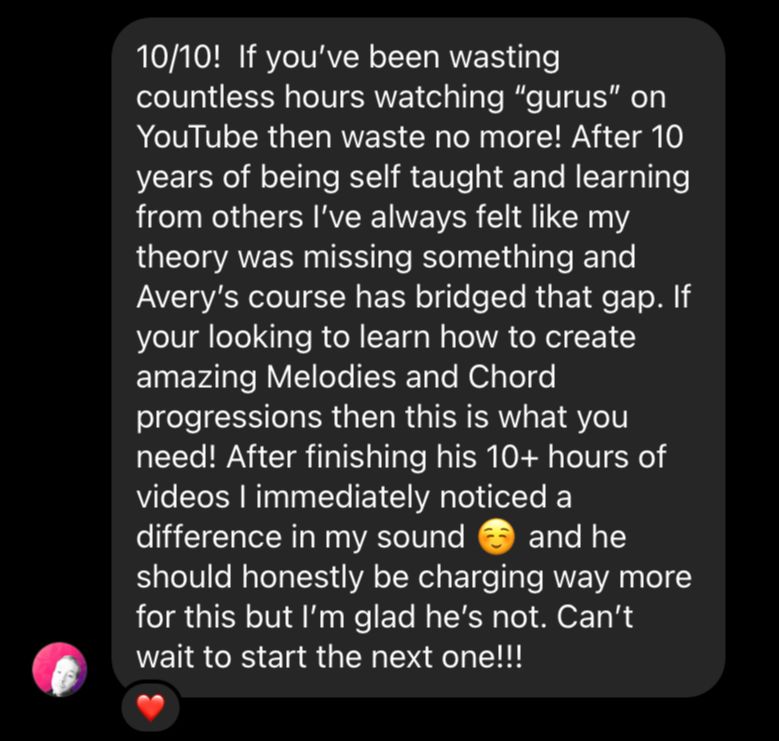
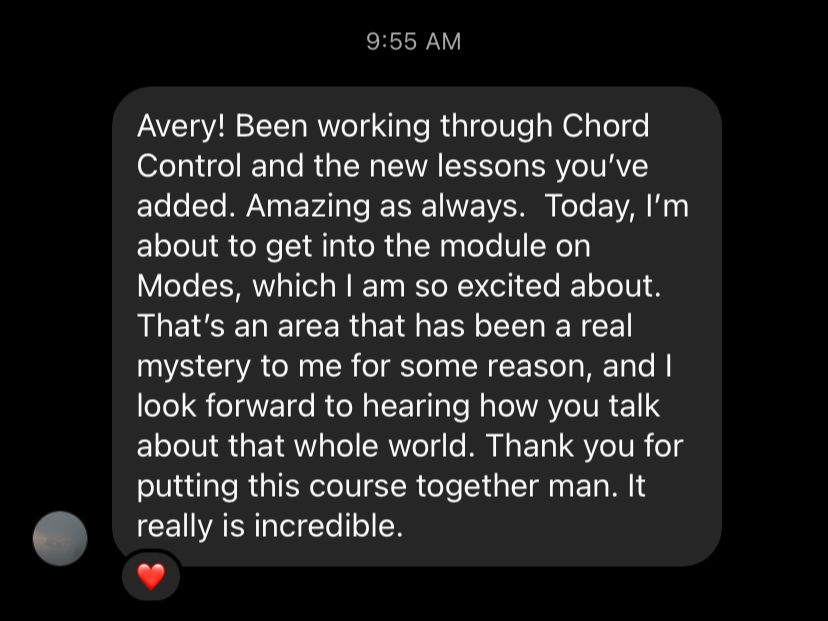
Join Hundreds of Students Improving Their Writing
"I can't recommend Avery's course enough."
He approaches chord building and producing concepts better than any other teacher I've found online.
The money I invested has paid itself back in time saved and skill improvement. Less searching on YouTube, more writing and producing with intention.
If you wanna become a more confident and efficient writer & producer, Avery's your man.
Tyler Lombard,
U.S. Billboard #1 and Platinum-selling Songwriter
Full Curriculum
-
WELCOME!
1 lesson- Start Here - The music production order of importance
-
THE SKETCH TO PRODUCTION WORKFLOW
2 lessons- The Sketch to Production Workflow
- Sketch to Production - Several Examples
-
MUSIC THEORY FUNDAMENTALS
6 lessons- Chords In The Major Scale & Intro to Roman Numerals System
- Chords In The Minor Scale & Roman Numerals
- Major vs Minor: It's Just Perspective!
- How to Get the Chords In ANY Scale (Featuring Double Harmonic Minor Scale)
- How to "Hear" Emotion in Scales
- Rhythm Fundamentals & "Feeling" Groove
-
HOW TO WRITE CLEAR SKETCHES & GENERATE ENDLESS IDEAS
6 lessons- Elements of an Effective Sketch
- Sketching in the Piano - Mindset + Several Examples
- Sketching in Strings & Guitar - Mindset + Several Examples
- Sketching with a Synth - Mindset + Several Examples
- Sketch Sessions - Where Idea Generation Meets Practice
- Sketch Session to a Drum Loop - How to Practice Idea Generation
-
CASE STUDY: SKETCH TO FINISHED PROFESSIONAL TRACK
2 lessons- THE STEP-BY-STEP CREATIVE PROCESS: From Sketching to Exported Professional Track
- THE TRACK-FINISHING CHECKLIST: Every step from sketch to finished track
-
HOW TO WRITE CHORD PROGRESSIONS
17 lessons- [DOWNLOADS] 100+ MIDI chord progressions + chord progression database
- How to Use Tonic, Subdominant & Dominant Functions
- Tip: Start from I vi or IV
- How to use "Substitute Chords"
- Substitute Chords In Action
- Writing Longer Progressions With Substitutes
- Writing Progressions In Minor
- Substitutions In Minor
- How To Use "Bass Inversions"
- How to Use Chord "Voicing" for Storytelling
- A Few Practical Voicings
- The Magic of I V vi IV
- The Magic of the i III VI VII
- "Diads" - How to Make Less into More
- STUDENT RECORDING: What are "passing chords?"
- Hooktheory
- Google Search for Chords
-
HOW TO ADD EMOTIONAL COLOR WITH EXTENSIONS
7 lessons- Building 7th Chords
- Building Extended Chords
- Sharp and Flat Extended Chords
- Writing Progressions With 7th Extended and Suspended
- Playing on the Keyboard
- 7th and Extensions under an Ostinato Examples
- QUICK TIP: Sus Chords vs Add Chords
-
HOW TO COMPOSE WITH MODES
10 lessons- Mode Chord Chart PDFs & Lesson
- Introduction to Modes
- Major vs Minor Modes
- Dorian
- Phrygian
- Lydian
- Mixolydian
- Locrian
- Modal Interchange
- Major Minor Interchange
-
HOW TO WRITE MELODIES
14 lessons- Setup, Repeat, Vary, Destroy
- Magic of the Pentatonic Scale
- How to Hear the "Personality" of Notes
- STUDENT RECORDING: Emotion of Notes
- How to write "Rhythm Melodies"
- How to Write Melodies on Chords
- How to Build "Ostinatos"
- How to Build "Arpeggios"
- How to Build "Riffs"
- How to Evolve a Melodic Idea
- Live 10 Minute Sketch Mindset Walkthrough
- STUDENT RECORDING: Melody Critique & Writing with Intention
- STUDENT RECORDING: Demonstration to help see "chords" as "melodies"
- STUDENT RECORDING: "Sky Full of Stars" - Coldplay (Theory & Recomposition)
-
HOW TO USE "JAZZ THEORY" TO WRITE COMPLEX PROGRESSIONS
12 lessons- IMPORTANT NOTE BEFORE WE START
- Intro to Secondary Dominant Chords
- Secondary Dominants In Action
- The Most Common Secondary Dominant Major V in Minor Progressions
- Instant Soul - Minor 7 9 Major 7 9 Trick
- Tritone Substitution
- Passing Diminished Chords
- Augmented b9 Dominant Chords
- Comparing SD TS PD
- Soul Progressions
- Chords In 5 Levels
- Tweaking a I vi IV V
-
HOW TO COMPOSE WITH ORCHESTRAL INSTRUMENTS
18 lessons-
Setting Up
- Recommended VSTs Sample Libraries
- Making Your Orchestral Template
- Navigating Sample Libraries Articulations
- Dealing with Delay in Instruments
- Using Modulation Expression
- Personality of Instruments
-
Composition Frameworks
- Orchestrating Chords The Power of Layering
- Orchestral Sketching
- Epic Ostinatos
- How to Compose Staccato String Momentum
- Creating Moods Setting Scenes with Chords Orchestration
- Ensemble vs Solo Sounds
- Solo Piano to Orchestrated Concept
- From Chords to Orchestration Demonstration
- Writing Orchestral Percussion Patterns
- Percussion Production Techniques
- Hans Zimmer - Time (Analysis & Transcription)
- STUDENT RECORDING: His MIDI Idea into Epic Orchestral
-
-
HOW TO COMPOSE WITH SYNTHS & DESIGN ESSENTIAL SOUNDS
38 lessons- [Download] Serum Presets
- [Download] MIDI From Lessons
-
Every Button In Serum
- Intro to Sound Design with Serum
- The Oscillators & Wavetables
- The Filter Compressed
- Envelopes, LFOs & Modulation Basics
- The Voicing Parameters
- The Macros
- The Mod Modulator
- Pitch Bend
- The Velocity Note Modulators
- Overview of the FX
-
Essential Chord Sound Design
- Supersaw
- Supersaw Stabs
- 3 Steps to Big EDM Chord Melodies
- Slow Closer
- Chord Wobblers
- Chord Pluckers
- Pads
-
Essential Bass Design
- Basic House Basses
- Midtempo Cyberpunk Bass
- Organ +7 Bass
- Plucker Bass
- Reso Bass Lead
- The 808 Bass
- The Sub Bass
- The Reese Bass
- The Pluck Bass
- Electro Slap House Bass
- Aggressive Bass FM
-
Essential Lead Design
- Arp Plucks
- Pluck Leads
- Sync Lead
- Supersaw Lead
- Sandstorm Lead
- Pitch Cycler Lead
-
Essential FX Design
- Tonal Risers
- Noise Risers
-
HOW TO BUILD A TRACK INSPIRED BY A REFERENCE
29 lessons- Introduction: What We Will Make
-
Planning & Reference Analysis
- How to Analyze a Reference Track
- Song Transcription in the Piano Roll
- Sourcing Presets
- Preparing Your Project
- How to Setup Custom Drum Kits - Splice Sample Picking
-
Writing The Song
- Writing Our Verse
- Writing our Pre-chorus Buildup
- Writing the Drop Chords (read description)
- Writing our Drop Melody
- Refining the Drop Melody
- Adding Sidechain Compression to Drop
- Writing our 2nd Verse
- Writing the 2nd Prechorus Buildup Drop
- Writing our Outro
- Full Sketch Listen Through & Small Adjustment
-
Mixing / Mastering
- The 6 Mixing Tools
- Mixing the Arpeggios
- Mixing the Verse Chords
- Mixing the Verse Bass & Adjusting Everything Together
- Mixing the Verse Drums FX
- Checking the Output Level Before Mixing Farther
- Mixing the Drop Part 1
- Mixing the Drop Melody
- Mixing the 2nd Verse
- Prechorus Build Drop Mix Check
- Checking the Final Mix
- Mastering Part 1
- Mastering Part 2
-
GO INSIDE PROJECTS
28 lessons- Take It (Electronic Pop)
- Adventure Awaits (Epic Orchestral)
- All Around Us (Electronic Pop)
- Hydra (Rock Orchestral)
- Village Shop Theme (Intimate Orchestral)
- How To Write Melodic EDM Drops (Songwriting Framework from Sketch Session)
- Hero Emerges (Epic Orchestral)
- Inspiring Future (Epic Orchestral Hybrid)
- Tornado (EDM)
- Electronic Rock
- Universe (Electronic Pop)
- Devastation (Dark Epic Trailer Hybrid)
- Wurld (Epic Orchestral)
- Technology Electronic (Made for Stock Library)
- Epic Action Trailer (Made for Stock Library)
- Custom Music to a Brand Video (Fiverr Gig)
- Beat Your Meat (Custom Theme for Indie Game)
- 4 Trap Tracks for Sports (Made for Major League Baseball Network)
- Real To The Ends (Trap Beat)
- We Crush It (Electronic Beat made for Sports TV)
- Liftoff (Trap Electronic Pop)
- Dreaming (Electronic Pop with Vocal)
- Making a Dynamic Soundtrack (Above Ground vs Underwater, Same Theme)
- Voice Memo to Production: Melodic Cinematic Electronic
- Forever (Piano Buildup)
- Synthwave - Chord sketch to production concept
- Trance - Chord sketch to production concept
- Nudisco - Chord sketch to production concept
-
BEING A PROFESSIONAL
13 lessons- How To Get Good: Everything In One Video
- My Fiverr Interview: Working as a Music Freelancer
- The 3 Step "Inevitable Success" Plan
- Mindsets that Help Me Stay Consistent Over Years
- What is a "Professional" Song?
- STUDENT RECORDING: Philosophy of being a creator & the "3 Buckets" to categorize each song into
- Active vs Passive Income
- How to Get Work: The Big Picture
- Growing your "Authentic Opportunity Network"
- Production Music Libraries - How to Get Your Music Into TV, Film & Advertising
- Licensing a song for 1,200 - Email Exchange with Music Production House
- Intro to Performance Rights Organizations
- Reaching Millions through Stock Music - Avery Berman Interview